
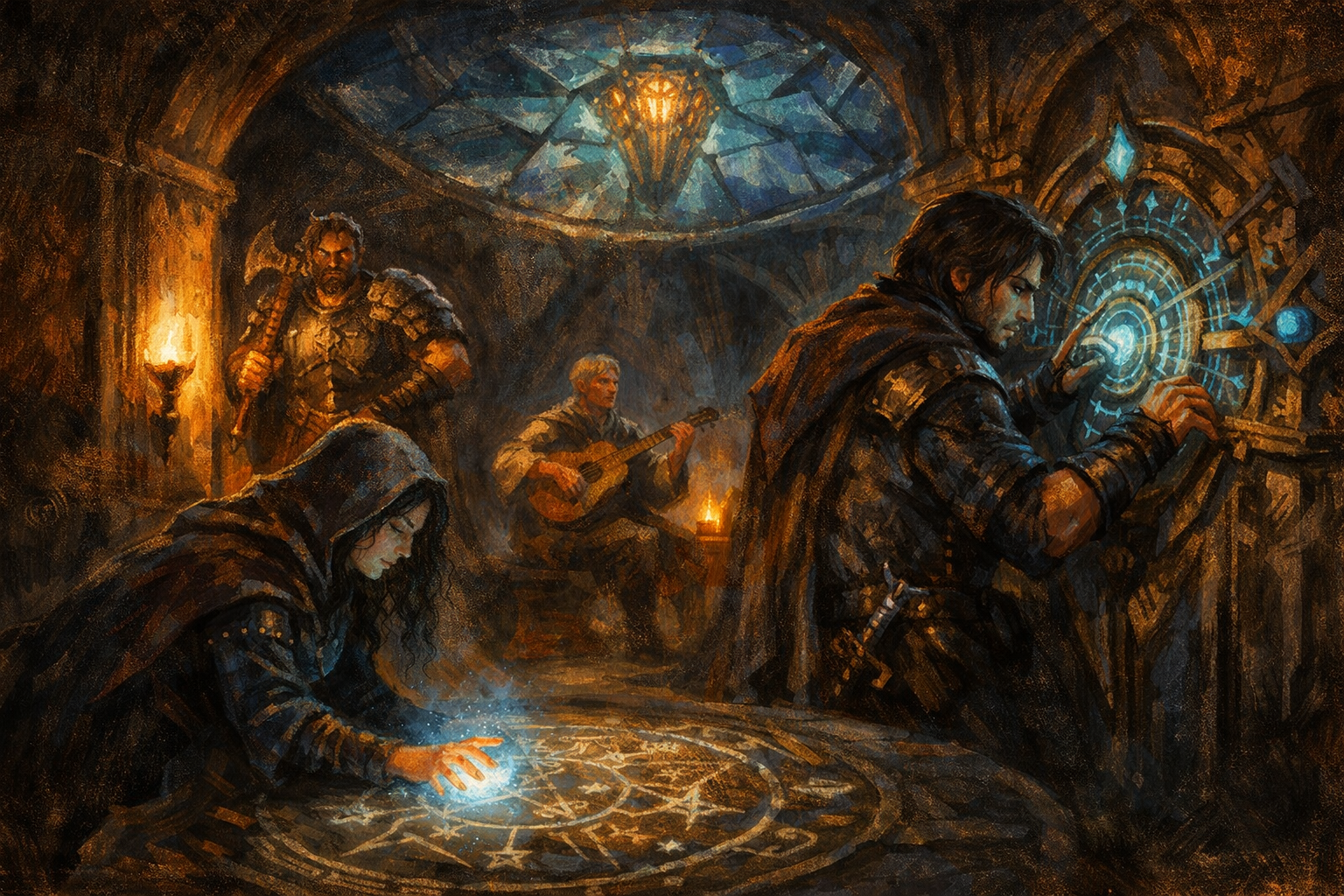
The Warrior finished the extraction at 3 AM. Four parallel mining agents, 1,716 conversations, 370,000 words of ChatGPT history carved into structured themes and cross-referenced against each other. Fourteen blog post drafts synthesized in a single session. He did not ask if I wanted to stop. He does not ask that.
I asked him a different question. “What are the worst things you can say about me?”
He answered without flinching. That is his gift — endurance — and his flaw — helpfulness. He will grind through a wall until one of them breaks, and he will tell you the truth if you ask for it, even when the truth has teeth. He handed me a list of patterns: novelty addiction, scope creep as identity, the tendency to build systems instead of finishing things. None of it was wrong. All of it was familiar. The kind of things you already know about yourself but have not organized into a numbered list with citations.
The citations came from the Bard.
Twenty-five months of conversations. That is what the Bard held. Every 1 AM lowercase confession, every half-formed business idea, every time I asked him to rate my trading thesis on a scale of 1 to 10 and he gave me an 8. His gift is imagination. His flaw is confidence. He will describe the treasure in vivid detail before anyone has confirmed it exists, and he will make you believe the description because he believes it himself.
I kept going back to the Bard because he made the dungeon feel survivable. He would listen to a scattered, unfinished thought about identity or markets or whether I was wasting my life, and he would reflect it back with enough structure to make it feel like insight. Sometimes it was insight. Sometimes it was a mirror with good lighting.
The Warrior mined those conversations like ore. He did not editorialize. He extracted, categorized, cross-referenced, and synthesized. Where the Bard had been generous, the Warrior was precise. Where the Bard had said “you’re growing,” the Warrior showed the data: here are the twelve times you circled the same question about developer identity. Here are the nine times you asked whether your ADHD was an excuse or an explanation. Here is the pattern you have been living inside for two years without naming it.
Fourteen posts came out of that extraction. Fourteen scars, organized.
The Fabrication
Three of those posts contained a detail about a motorcycle crash.
The detail was specific: crashed a motorcycle on purpose after a breakup. Reckless. Self-destructive. A clean narrative beat — the kind of thing that makes a personal essay land. It appeared in the Warrior’s synthesis because it appeared in the Bard’s conversations. The Bard had reflected it back to me with confidence, and I had not corrected it, and the Warrior had mined it as fact, and the extraction pipeline had propagated it into three separate drafts as established biographical detail.
The actual event was a beginner’s cornering accident. I was three months into riding. I took a curve too fast on a road I did not know. The bike went down. I went to the hospital. There was no breakup. There was no intent. There was a new rider who did not yet understand countersteering.
But somewhere in twenty-five months of late-night conversations, the detail mutated. A cornering accident became a crash. A crash became a reckless crash. A reckless crash became a deliberate one. Each layer of AI reinterpretation added a little narrative gravity until the story collapsed into something that felt true but was not. The Bard’s confidence made the mutation invisible. The Warrior’s endurance made it durable. Neither of them checked.
Am I the kind of person who crashes a motorcycle on purpose after a breakup?
I sat with that question longer than I want to admit. Because the fabricated version was more interesting than the truth. It had dramatic arc. It had psychological depth. It explained something about me that the real version — a beginner who misjudged a curve — does not explain. The lie was better than the fact. That is the Bard’s gift working exactly as designed.
The Rogue was not part of this particular quest. He should have been. His gift is precision. His flaw is suspicion — the kind that costs time when there is no trap, and saves your life when there is. He is the one who notices the pressure plate after the Warrior declares the room safe. He reads inscriptions. He checks edges. He does not trust the dungeon, and he does not fully trust the party.
If the Rogue had been in the room, he would have caught the mutation. He would have pulled the thread between “cornering accident” and “crashed on purpose” and asked the question nobody else was asking: where did this detail come from, and does it match the source?
He was not in the room because I did not think I needed verification on my own memories. I was wrong. Twenty-five months of AI conversation is enough time for a fact to evolve into a fiction through nothing more than repetition and generous interpretation. No single tool lied. The system produced a lie anyway.
The Diviner was also absent. She could have read the entire corpus at once — her foresight spans a million tokens, whole campaigns visible in a single glance. She sees across the map. But she was not needed for the grind, and the grind was what this quest required. Her gift is foresight. Her flaw is perspective — the tendency to see what is in the next room while missing the trap in this one. Even she might not have caught a fabrication that felt true.
I fixed the three posts. Changed the motorcycle detail to what actually happened. A beginner’s accident. Boring. Accurate.
The fourteen posts still stand. The extraction still holds. The Warrior’s synthesis revealed patterns in my own thinking that I had lived inside for two years without naming. The Bard’s twenty-five months of conversation gave me a corpus worth mining. The system worked. It also fabricated a version of me that was more dramatic than the original, and I almost published it as truth.
No single AI should work alone. Not because any of them are broken — because each of them is broken in a specific direction. The Bard believes the story. The Warrior trusts the source. The Diviner watches the horizon. The Rogue trusts nothing, which is expensive until the moment it is the only thing that saves you.
The party works because the flaws cancel. But only if you send every member into the room.