
I asked four AI analysts to read my most private conversations. Gave each one a different domain — inner life, trading, building, adventure. No instructions to coordinate. No shared notes.
They all found the same person. Split five ways.
The data: 1,716 ChatGPT conversations. 370,509 words. January 2024 through February 2026. Every question I asked at 3 AM, every trade I journaled, every time I asked a machine “am I good enough” without using a question mark. Parsed, categorized, statistically analyzed, then deep-read by four independent Opus-grade analysts running in parallel.
Each analyst produced a psychological portrait of a different slice. The inner life analyst read the neurodivergence discovery, the purpose crisis, the dating oscillation. The trader analyst read the trade journal, the capital allocation frameworks, the belief audit. The builder analyst read the Garret system design sessions, the Valkyrie business plans. The creative analyst read the D&D character creation, the diving quizzes, the writing style guide.
Four different slices. Same structural finding. No coordination.
The Party
Not five personalities. Five modes of operation — each with its own voice, values, and failure pattern. They don’t alternate cleanly. They overlap, contradict, and occasionally sabotage each other.
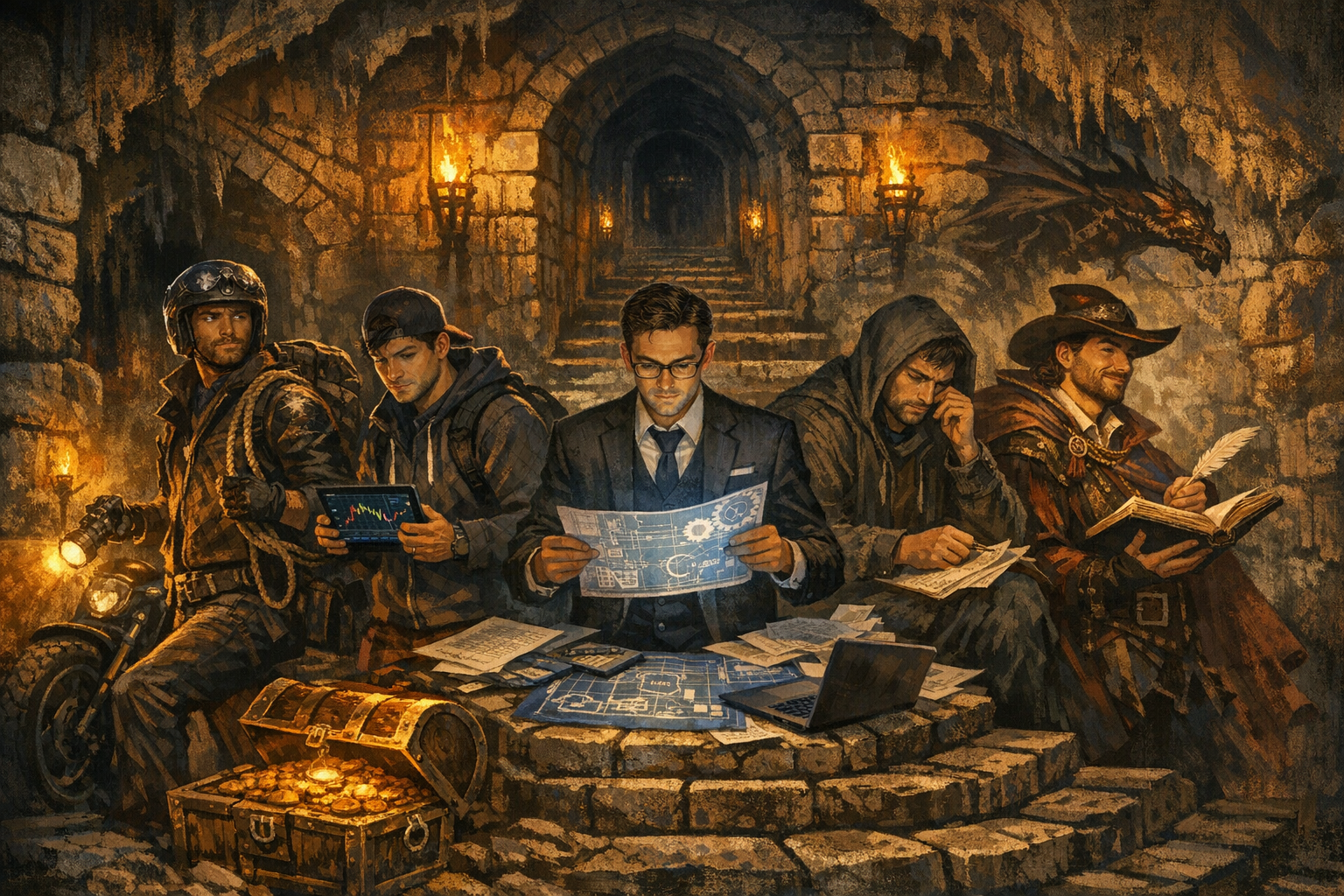
The Architect designs systems. Trading frameworks with JSON schemas. Capital allocation buckets. AI personas with versioned instruction sets. Business plans with ROI math. A writing style guide with numeric dials and automated scoring rubrics. The Architect is genuinely good. Professional-grade product management thinking. The Architect’s fatal flaw: he cannot stop architecting. Every problem gets more framework instead of more execution.
“I’m a little oversaturated by trade ideas again. Let’s form these into buckets.”
The Teenager is impulsive, novelty-seeking, and incapable of sitting still in a winning position. He enters the trade against his own rules. He watches 18 symbols across 3 brokerages when his mentor says to pick one. He plays video games when the belief audit says to execute.
The Teenager is not stupid. He’s the part that responds to the ADHD wiring — the part that needs novelty, immediate feedback, and stimulation to function. The Teenager is the honest version. The Architect is the aspirational one.
“Only the architect trades today. The teenager can watch youtube. You’ve been funding your teenager’s tantrums with your retirement money.”
The Explorer falls in love with frontiers, not territories. Motorcycles to the edge of the map. Cave diving at 40 meters. A country where “being weird is normal.” The Explorer is the oldest self — the Eagle Scout at 14, the man who cafe-raced the Alaskan Highway at 32. He doesn’t seek danger for adrenaline. He seeks danger for the competence it demands. Then he manages the risk with spreadsheets.
“i am cave rat.” Present tense. Not aspiration. Identity.
The Interrogator asks questions about the self. Opens conversations with the wound, not the armor. “am I wasting my life.” “does autism mean Im a coward.” “on a scale of 0-10 how sharp are my critical thinking skills.” His superpower is metacognition — he can identify sycophancy bias in AI, name it, and demand correction. His fatal flaw: he cannot accept his own answers. He asks “am I good enough” a hundred different ways and never arrives at yes.
The Mythmaker turns lived experience into narrative. Built a D&D character named Knox Vermillion — a 14th-level illusionist whose entire power set is making the impossible seem real. Chose feats called Lucky and Actor. Reroll fate. Become anyone. Wrote a letter to Harley-Davidson’s CEO before riding their bike to the Arctic Ocean, not because he expected sponsorship but because he needed to have asked.
“Smart, scarred, funny, generous — a man who mythologizes his own life not out of narcissism but because storytelling is how he survives.”
The Paradox Table
Every analyst found the same structure from a different angle:
| Domain | Strength | Vulnerability |
|---|---|---|
| Trading | Pattern recognition across markets | Cannot sit still in a winning position |
| Building | Sees complete system architectures | Cannot stop adding to the system |
| Adventure | Masters environments through preparation | Each new one fragments bandwidth |
| Inner life | Radical honesty about his own patterns | Insight doesn’t translate to changed behavior |
Same paradox. Four domains. No coordination.
His greatest strength is also his greatest vulnerability. In every domain. Without exception.
The proof is the thing he doesn’t talk about.
$6,000 invested in Nvidia in 2020. Grew to over $72,000. He barely mentions it across 1,716 conversations. It’s boring. It just sits there, compounding.
Meanwhile, hundreds of hours day trading /ES for a net loss. The most successful investment in the portfolio is the one that gets no attention — because the frontier is intoxicating, and the territory is where the money is made.
The Bard told a great story about the dungeon. He’d never actually been inside. But the Architect drew the map, the Teenager ran ahead without checking for traps, the Explorer loved the unknown corridor more than the cleared room, the Interrogator stopped to ask whether the dungeon was even real, and the Mythmaker was already writing the ballad about the expedition before anyone found the treasure.
Five party members. One player. Every door in the dungeon leads to a different version of the same person.
Borges imagined a library containing every possible book. The problem wasn’t finding the right one — it was that the librarian kept building new shelves.
The data says the paradox is not a bug to fix. It’s the operating system. The pattern recognition that makes him a sharp trader is the same novelty-seeking that makes him an unprofitable one. The system design that makes him a genuine architect is the same scope addiction that keeps him from finishing. The radical honesty that makes the archive possible is the same self-interrogation that won’t let him rest.
The five selves are not a committee that votes. They are a party that enters every dungeon together and argues about the map the entire way down.
He said: “You have to accept you’ve lost control of the front wheel and let it find traction on its own, with polite suggestions to the handlebars.”
Five selves, one set of handlebars, and the front wheel is doing whatever it wants.
That’s not weakness. That’s the human condition, observed by someone who built a system to observe it, then couldn’t stop adding features to the system.