
Hold to inflate.
Let go to vent.
Fathom is a side-scrolling scuba game with one control. Everything else is dive physics: the air in your BCD expands as you rise, your tank drains faster the deeper you go, and your tissues load nitrogen on the same decompression model dive computers use. There is a new reef every day and a ghost of your best dive to race.
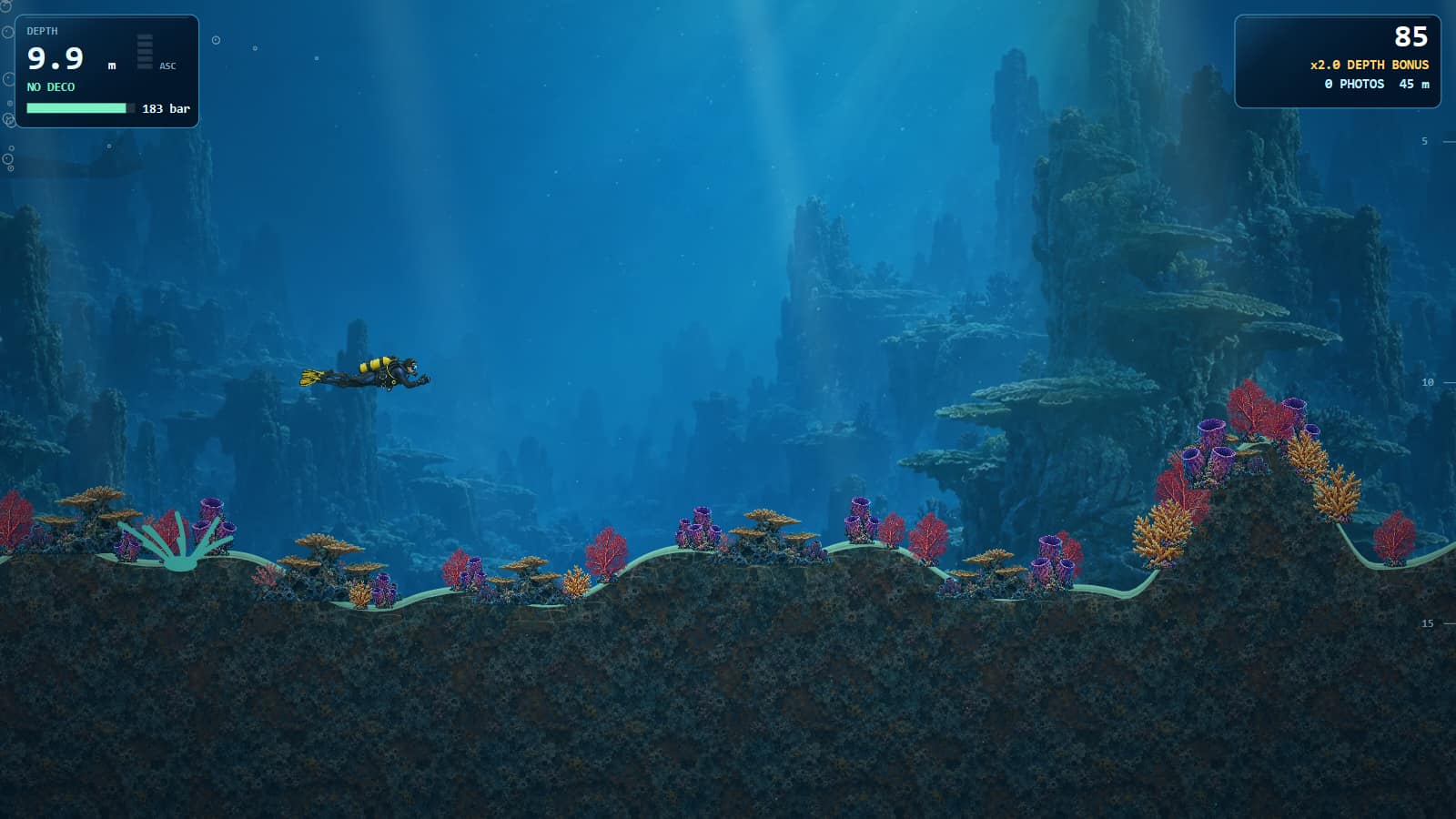
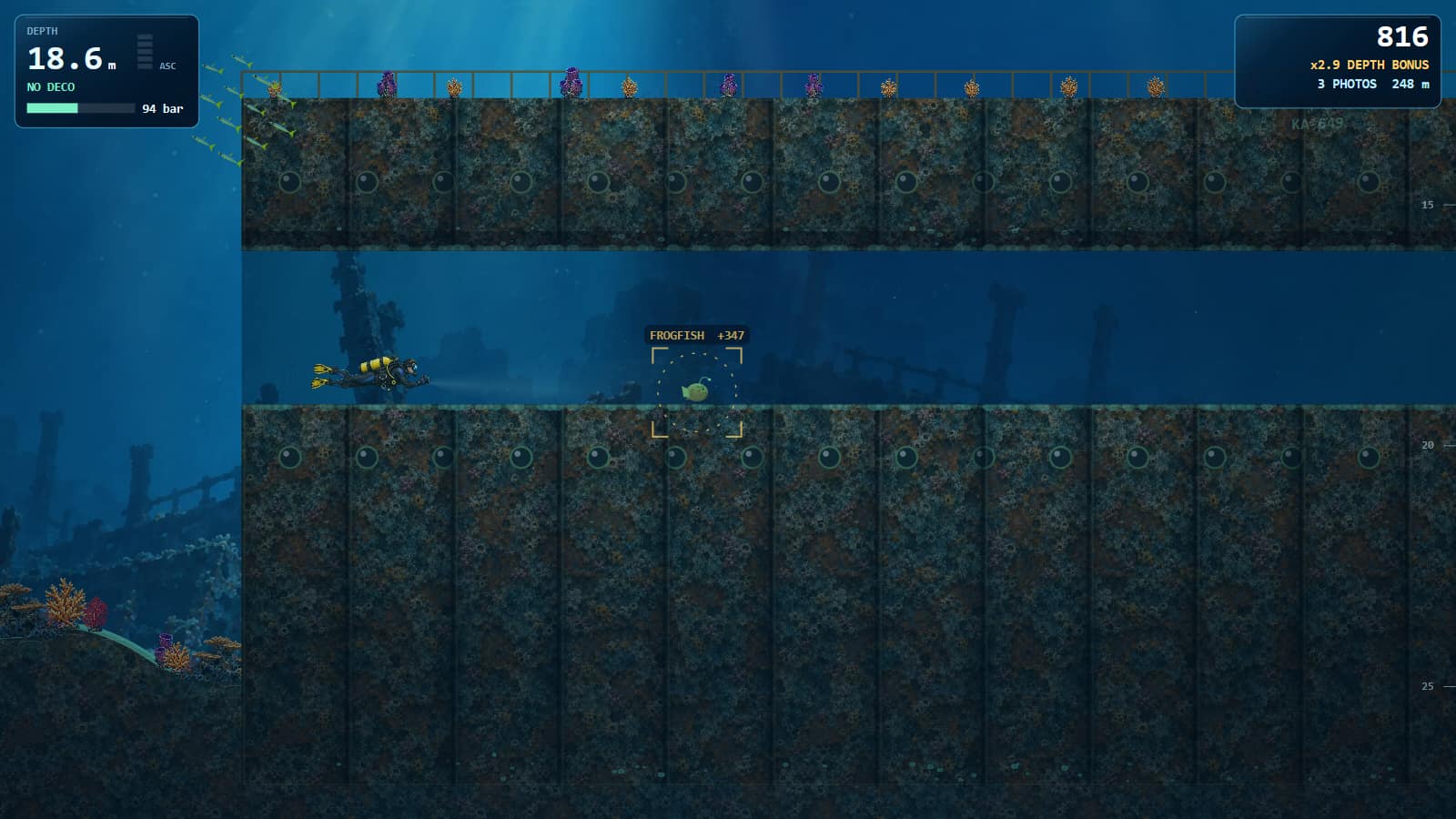
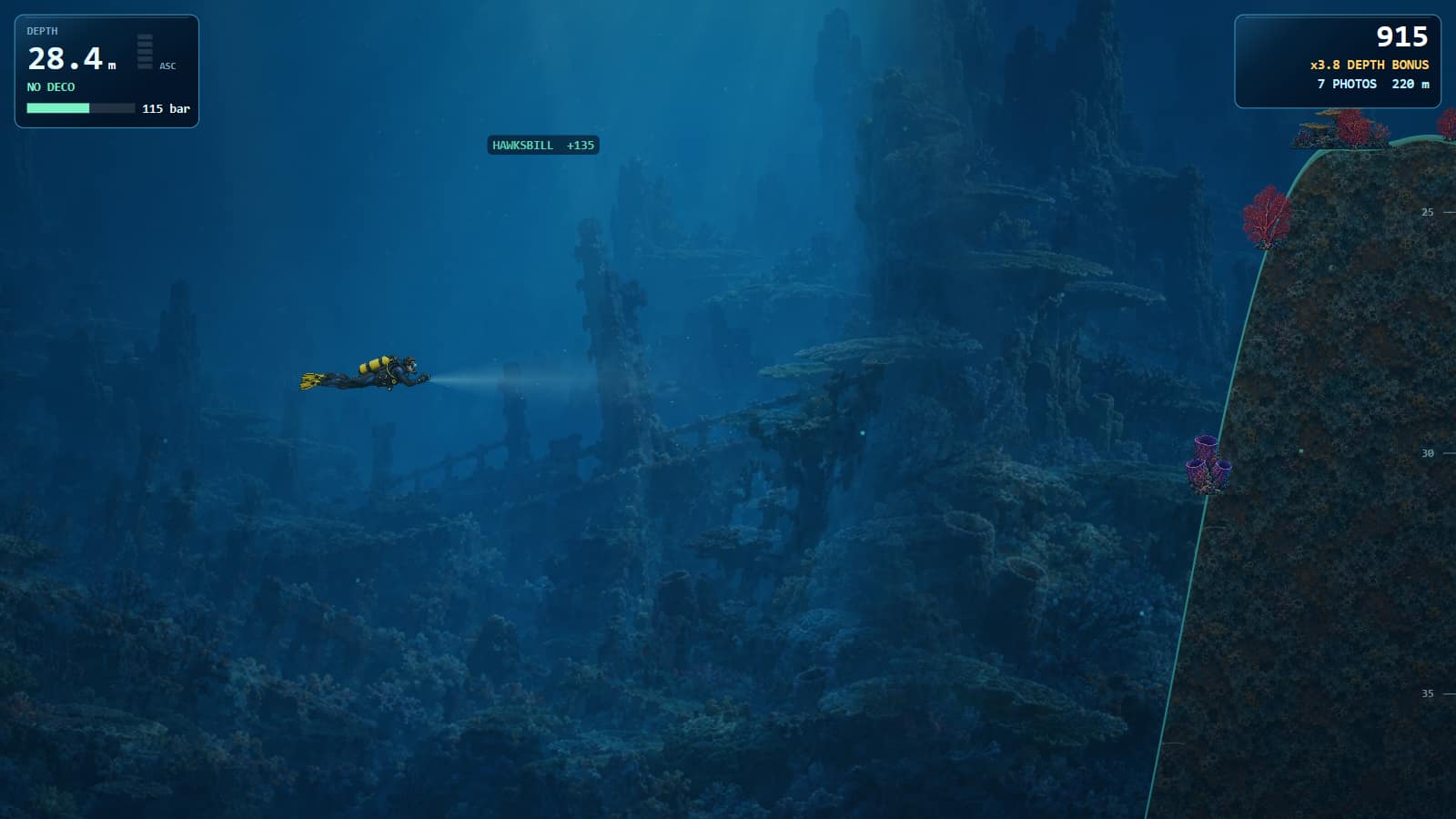
Two dive sites
Same diver, same physics, different water. Each site has its own daily reef, ghost and logbook.
Romblon The original reef
Gentle coral gardens, wrecks with swim-throughs, rock arches and ghost nets in clear blue water. Critter country: nudibranchs, frogfish, seahorses, and a whale shark if the wall is kind.
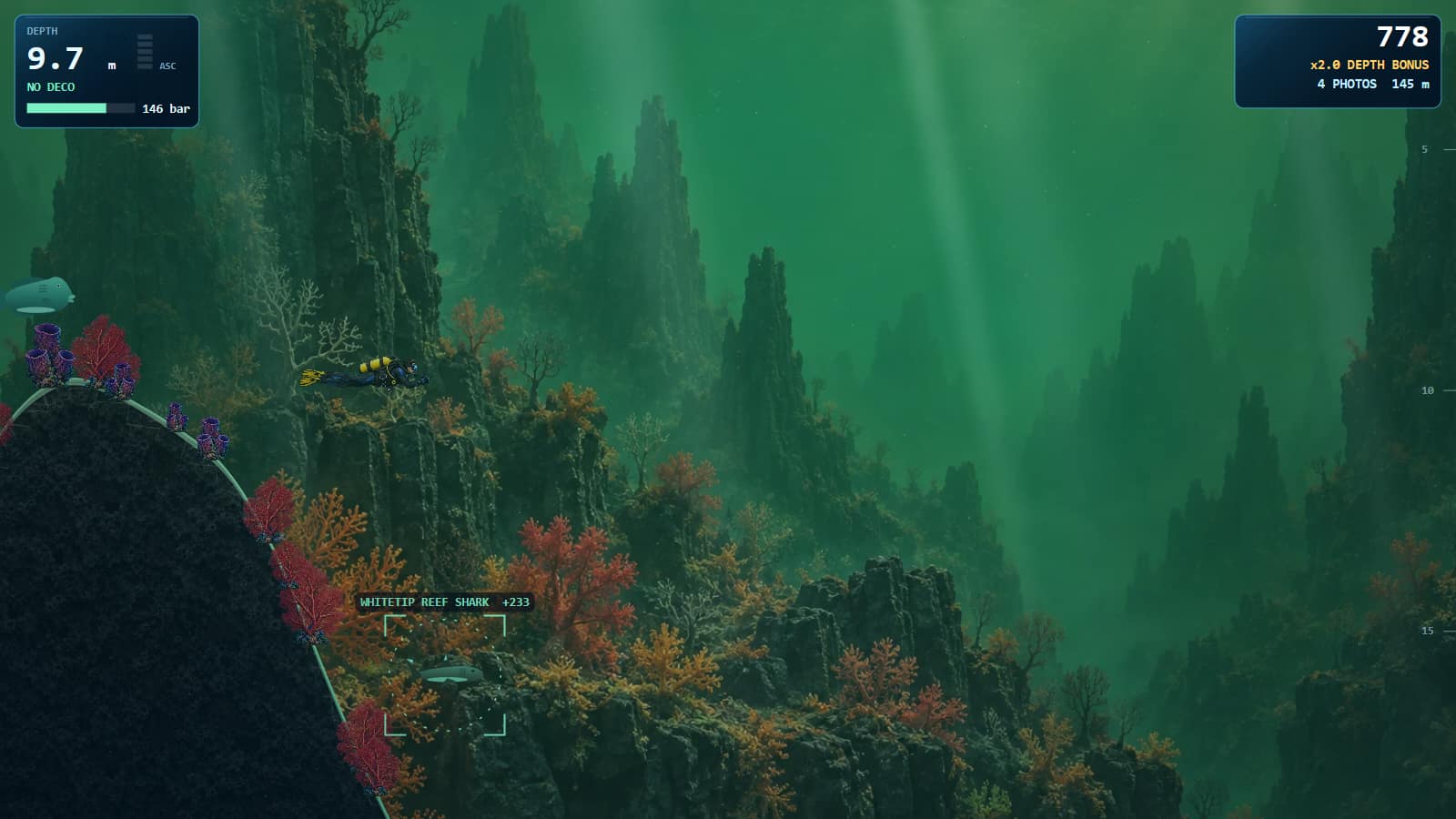
Komodo New
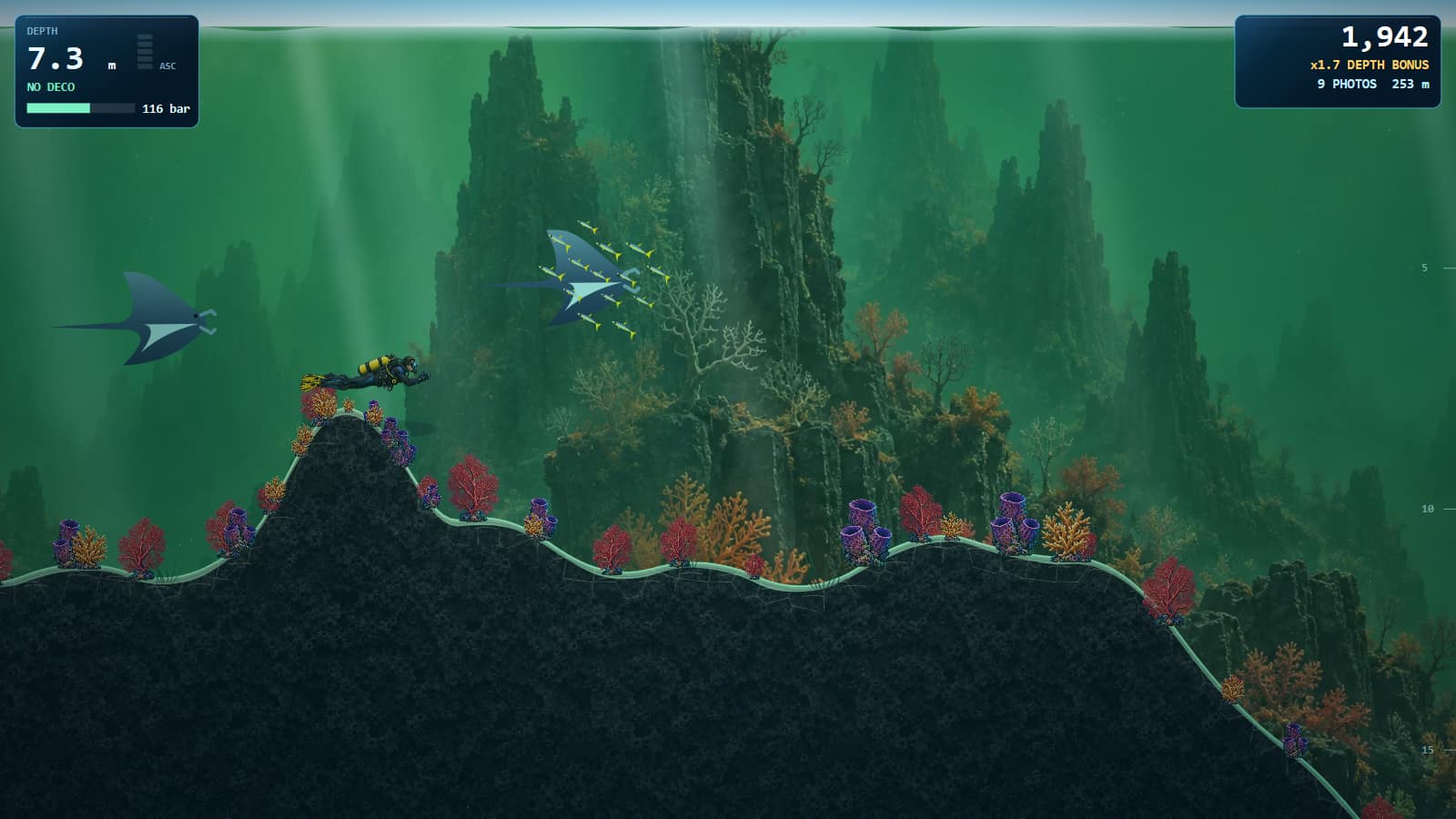
Pinnacles that rise from 30 metres to within 8 of the surface, manta cleaning stations, and the cauldron, where the water sinks in one cell and wells up in the next. Green water, soft coral, whitetips, Napoleon wrasse, bumphead parrotfish, a pygmy seahorse you have to get close to the reef to find, and a titan triggerfish guarding its nest.
Where it fits
Keystone builds software people lean on: an emergency hotline directory, a booking system, a storefront, public data tools. The rules are the same on every project. It has to work on the phone in your hand, and the numbers behind it have to hold up when someone checks.
A game is the least forgiving place to follow those rules. Nobody reads a changelog before deciding a game stutters or cheats; they close the tab. So Fathom got the treatment everything else gets: a model we can test, a replay we can verify, an autopilot that checked the levels can be survived, and a written list of every shortcut.
Phone first
One thumb on the glass is the whole control. Physics runs at a fixed 60 steps a second and the picture is interpolated between them, so a 120 Hz phone is smooth without the physics changing. It respects the notch, buzzes on Android, and needs no network once it has loaded.
Numbers that hold up
The same seed and the same inputs give the same dive, bit for bit. That is what brings your best run back as a ghost, and what would let a leaderboard re-run a submitted score instead of trusting it.
Built by a diver
The founder is a TDI/SDI Divemaster. The runaway ascent near the surface, the tank that drains four times faster at 30 metres, the ceiling that pins you down after a deep excursion: that is how diving feels, not how games usually pretend it does.
It is also the pocket edition of TRIM, our dive simulator for instructors. Same physics, different job. TRIM is a classroom tool you spend an hour in. Fathom is a minute anyone can pick up, and a good reason to ask what that red line on the screen means.
The physics you can feel
This is the model the game runs, not an illustration of it.
| Depth | Pressure | Same air in your BCD | Wetsuit lift lost | Air per breath | Score | Deco ceiling after 60 s |
|---|---|---|---|---|---|---|
| 0 m | 1 atm | 100% | 0 L | x1 | x1 | none |
| 10 m | 2 atm | 50% | 1.6 L | x2 | x2 | none |
| 20 m | 3 atm | 33% | 2.1 L | x3 | x3 | 2.2 m |
| 30 m | 4 atm | 25% | 2.4 L | x4 | x4 | 7.7 m |
| 40 m | 5 atm | 20% | 2.6 L | x5 | x5 | 13.3 m |
Pressure is 1 atm plus 1 for every 10 metres of seawater. Ceilings are the shallowest depth the tissue model allows after holding that depth for a minute of play, at a gradient factor of 70.
Rising feeds itself
Near the surface a small change in depth is a big change in volume, so an ascent speeds itself up. Most first dives end at the surface. That is Boyle's law, and it is why real divers vent early.
Depth costs air
Every breath at 30 metres takes four times the gas it would at the surface. Going deep pays four times the points and empties the tank four times as fast.
Nitrogen has a memory
Stay deep and the tissue model builds a ceiling you cannot swim above. Cross it and the dive ends. Fast tissues clear quickly; the slow ones make you wait.
How it is built
Deterministic simulation
The physics module never touches the page, never calls a random number generator and avoids trigonometry inside a step, so a run plays out the same way every time. Rendering reads the state and never writes it.
Ghosts from button presses
Your best dive is stored as the moments you pressed and let go, delta-encoded. Replaying that list against the same seed rebuilds the whole dive. That replay is the ghost you race.
A new reef every day
The reef is generated in 40 metre chunks from a hash of the day and the chunk number, so any chunk can be built in any order and dropped once you pass it. Everyone gets the same Daily Dive.
Light that behaves like water
Red fades first as you descend, then green, following Beer-Lambert absorption per colour channel. The camera strobe restores true colour for a moment, and a torch comes on as the light goes.
No dependencies
Canvas 2D, WebAudio and plain ES modules. No framework, no build step, no image or audio files: the reef, the fish and the regulator breathing are drawn and synthesised in code. View source works.
A reef that reacts
Fish school and scatter when you swim into them, sunlight moves across the sand, and below 20 metres the plankton glows as you pass. None of it can touch the score, because none of it lives in the simulation.
How we know it is fair
Fair is a claim, so it gets evidence.
- Fifteen unit tests run with the rest of this site. They check that a replay reproduces a dive bit for bit, that input recordings round-trip, that the same gas takes a quarter of the volume at 30 metres, that air use scales with pressure, that the decompression ceiling grows with time at depth, that a held inflator ends in an uncontrolled ascent, that reef chunks come out identical in any order, and that the seabed never rises within 6 metres of the surface on 40 test reefs.
- A lookahead autopilot flew 30 generated reefs. It tries eight inflator rhythms 2.5 seconds ahead on the same deterministic simulation and keeps the best. 24 runs were still going at 150 seconds, 4 ran out of air, and 2 died in ghost-net sections where the generator had stacked obstacles too close together. Seabed hazards are now kept clear of nets and arches.
- An earlier autopilot run hit a coral mound that rose to 1.5 metres below the surface, a gap no player could pass. The seabed now flattens toward 6 metres and never crosses it.
- A player reported air tanks stuck inside the reef. An audit of 200 daily reefs found 261 of 1,141 tanks (23%) had spawned under the seabed or inside a wreck, arch or net, because tanks were given a depth without checking what was there. Every tank and animal now moves to the nearest open water, the audit reads zero, and a test keeps it there. The fix moved nothing else: terrain and hazards came out bit-identical on 8,000 chunks, so saved ghosts still replay.
- Komodo went through the same gate. The autopilot flew 30 Komodo reefs: 27 were still going at 150 seconds, the 3 losses all ran out of air, and none hit anything. Tests check that no hazard sits on a pinnacle crest, that no current is stronger than a BCD can beat, and that every species in the Komodo logbook actually spawns.
- Adding a second site could not be allowed to move the first. A test hashes everything Romblon generates (seabed, obstacles, hazards, animals, tanks, currents, scenery) across 500 chunks and pins the result, because saved ghosts and the Android app both depend on that reef staying exactly where it is.
- The same autopilot flies the title screen, and it flew the dives in the screenshots on this page.
What is simplified
Every shortcut, written down, so nobody mistakes a convenience for the truth.
Time is compressed. A real minute of nitrogen loading happens in 1.5 seconds of play, and the diver moves up and down faster than a real one would.
It uses 4 of the 16 ZHL-16C compartments, the fast ones a short dive actually loads, with a gradient factor of 70.
Light absorption is softened. Real seawater strips red faster than the game does; at true rates the reef would be grey by 10 metres.
The diver swims forward on their own, and the floating air tanks are a game device. Nobody hands you gas on a real dive.
It has not had a big playtest yet. The constants were set by measurement and by the autopilot. Real players will move them, and we will say when they do.
It is not a training tool. For practising the real thing, there is TRIM, and then there is an instructor.
Go diving
Any phone or desktop browser. One thumb, about a minute a dive.